

In a congregation of flashing fireflies, every one is continually sending and receiving signals, shifting the rhythms of others and being shifted by them in turn. Out of the hubbub, sync somehow emerges spontaneously.
Steven Strogatz, Sync: How Order Emerges from Chaos in the Universe, Nature, and Daily Life
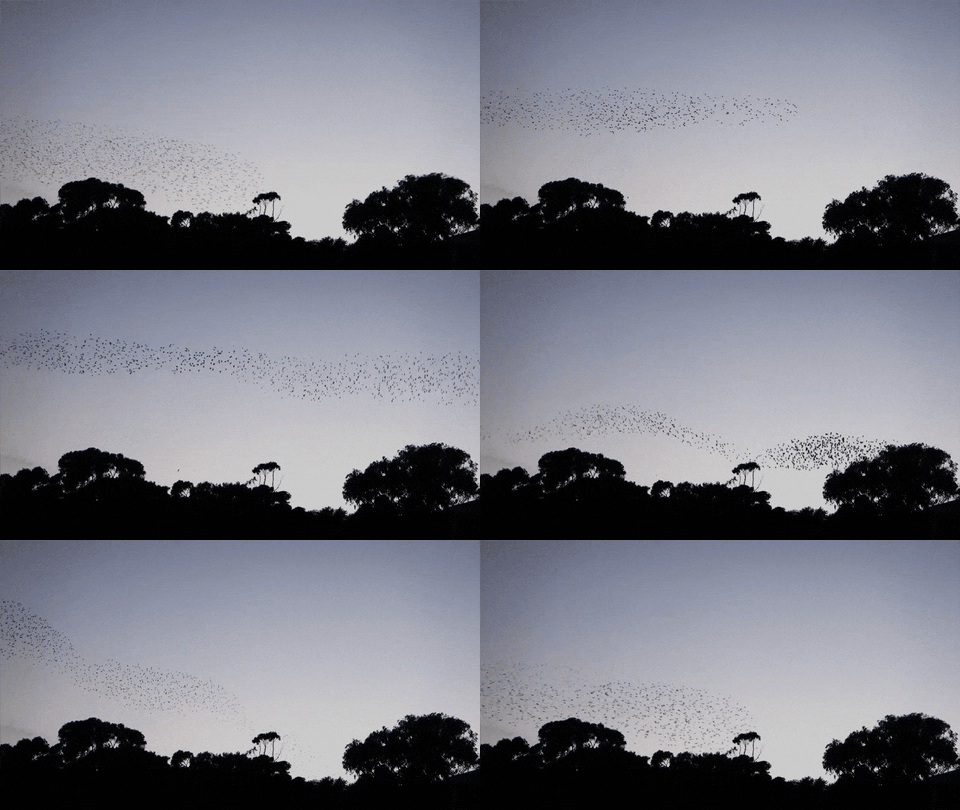
Remember when you were a kid watching birds flocking in formation and at some point thinking, hang on, how do they all know what to do?

Maybe it was just me.
Anyway, I used to wonder how they could all fly in perfect synchronicity. Surely there was a leader in the flock, conducting things in a way that we humans can’t understand. Maybe some kind of shared communication, at least.
Except, of course, there isn’t - it’s emergence, the phenomenon of individuals and groups acting somewhat independently, and their collective behaviour produces something entirely new that none of the individual parts could do on their own.
Because, like a group of birds producing emergent flight patterns, the modern company is probably the closest thing we already have to biological AGI.
Not artificial general intelligence, obviously. The components are mostly human, notwithstanding those particularly boring internal meetings.
Emergence is everywhere in daily life. Which brings us, naturally and gracefully, to ants.
COLONY ANT-ICS
Ant colonies are one of the most well-known examples of emergence in nature. When they’re not trying to find ways into your kitchen to lay waste to your sugar, the ants divide themselves between finding food, tending larvae, defending the nest, maintaining it and removing waste. They respond to shortages and threats. They reallocate labour. Like the little communists they are.
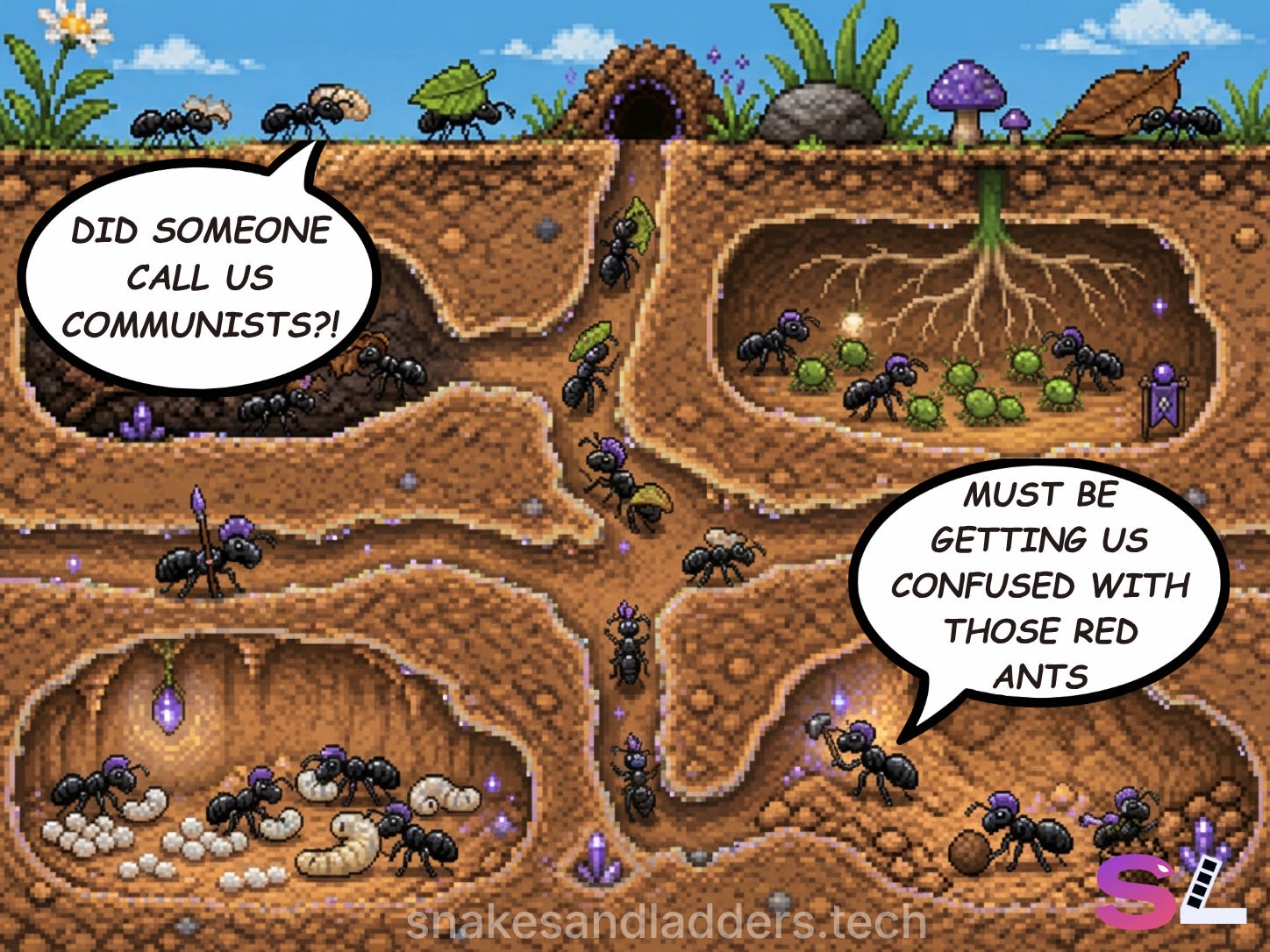
Collectively, the colony behaves so much like a single living creature that scientists describe it as a superorganism.
Except there isn’t an ant CEO controlling every single ant. The queen isn’t reviewing the foragers’ OKRs and she didn’t green light that restructure in the aphid department. No single ant understands the whole colony, but the colony can behave as if it understands itself.
We talk about them as if they are people. The company decided. The company believes. But what exactly is “the company” in that sentence?
A CEO sets direction and senior leaders have considerably more influence than everyone else, but no individual contains the whole company. Most people can only see what happens in their part of it, and if they do have a wider view, it’s relatively shallow. Philip Anderson’s 19991 paper describes organisations as complex adaptive systems in which local agents adapt within environments shaped by management. Put less academically, the company we eventually observe is the combined result of different people making decisions within the information, incentives, power and risks immediately around them.
None of them needs to understand the whole system to help create its behaviour.
CORPORATE PHEROMONES
In many ant species, a forager that finds food leaves a pheromone trail. Other ants detect the trail and follow it. If they also find food, they reinforce the route with more pheromones, which attracts more ants, which reinforces the trail again. The colony appears to have made a decision.
Except it hasn’t, at least not in the way we understand decisions. A signal has been repeated until it becomes the route everyone follows.
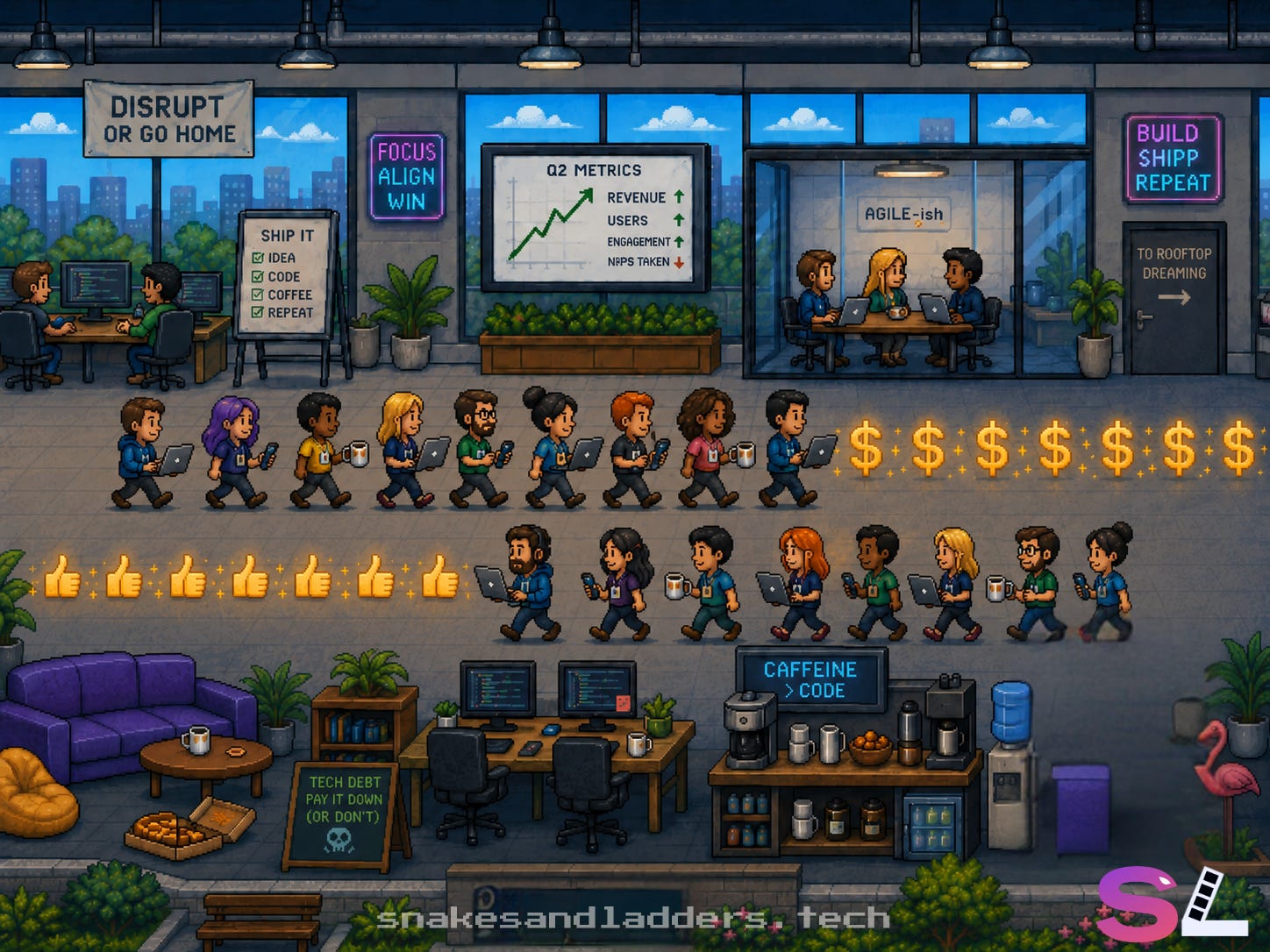
Companies and the GTM orgs within them have their own pheromones:
Whether someone gets recognised or ignored for surfacing a risk early,
Whether someone can correct a senior leader without first updating their resume,
Who is promoted for improving a shared outcome, not merely protecting their own number,
Whether leaders publicly change their minds when the evidence changes,
Whether people who connect information across functions are valued,
What happens when someone refuses to create activity that will make the dashboard prettier and the customer experience worse.
These signals tell people how to succeed, whether the company values align or not. Research2 on organisational routines distinguishes between the official understanding of how work is done and what people actually do. The two shape one another over time - for good or for ill.
The company values might say that everyone should “display autonomy” or “growth mindset” or whichever selection of pleasant words survived the branding workshop. But the real instruction is what happened to the last person who challenged something important.
If they were rewarded, others will do it.
If the challenge itself became a problem, others will learn from that too.
WELLS FARGO’S ANT-ICS
This is where corporate pheromones stop being an interesting nature analogy and start getting rather expensive.
Wells Fargo’s story began with an idea that sounded perfectly sensible. Existing customers might need more than one financial product, so employees should identify those needs and sell accordingly.
Then the idea travelled down the organisation.
Sales goals were assigned to regions, branches and individual employees. Performance appeared in daily reports and scorecards. People were ranked against their targets and one another. Incentive pay, performance reviews and career prospects became increasingly connected to how many products they sold.
None of this required an executive to issue a memo entitled Please Open Bank Accounts Without Permission. The signals were considerably more civilised than that. Meet the number and receive money, status and career security. Miss it and receive scrutiny, shame or the distinct impression that your employment had become a little more optional.
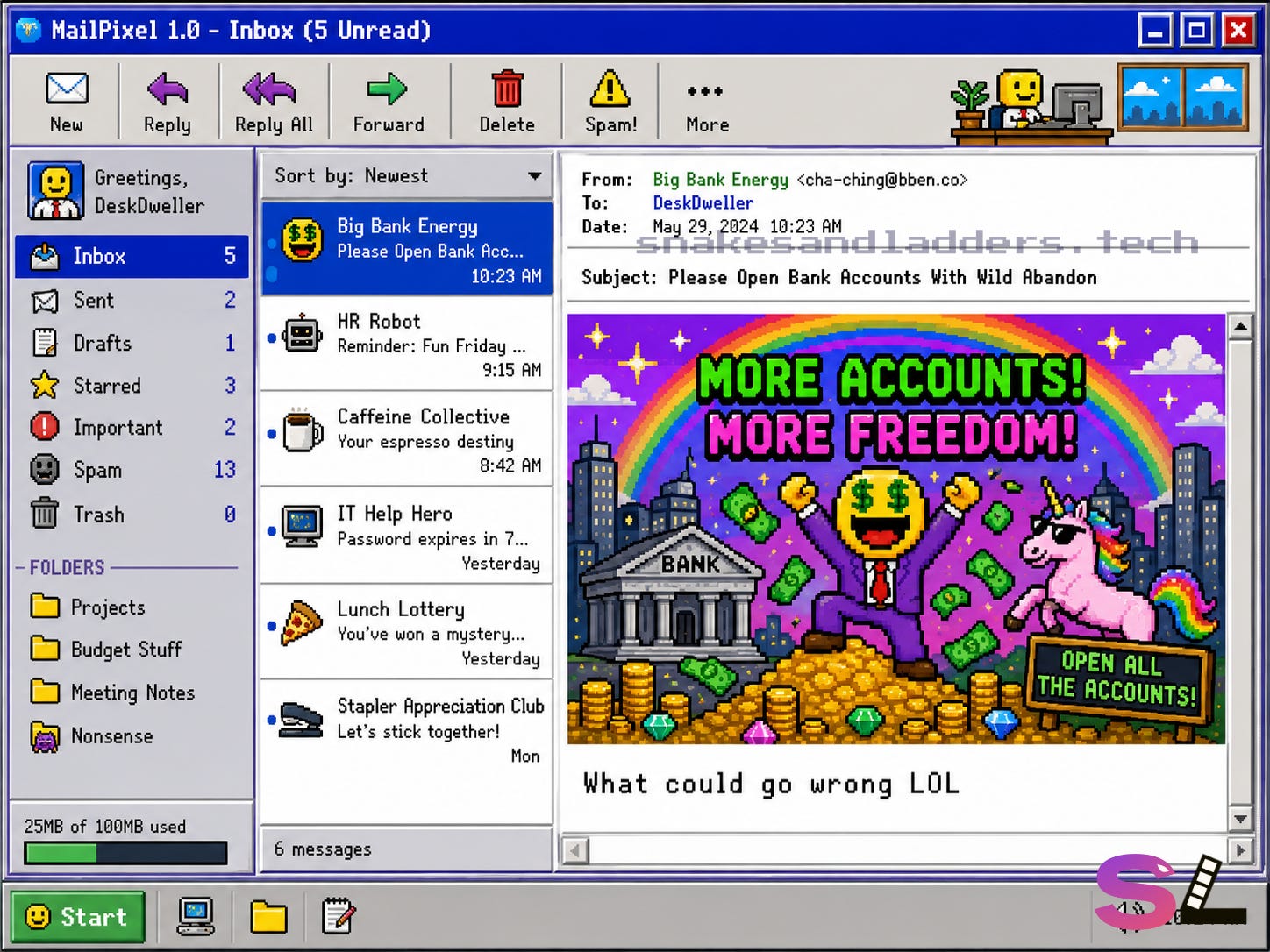
Employees began creating accounts customers had not requested. Some moved money from authorised accounts to make new ones appear funded. Others created email addresses, requested debit cards or applied for credit cards without the customer’s consent. These were individual choices, and some were plainly unlawful. But they were choices made repeatedly inside the same system, under the same pressure, in pursuit of the same measure.
When misconduct was discovered, Wells Fargo dismissed the employees responsible. Locally, that also made sense. A rule had been broken, the rule breaker was removed and the control system could congratulate itself on another successful outing. Yet the response kept treating thousands of cases as employee-level violations, even as their sheer volume became evidence about the system itself.
Between 2011 and 2015, Wells Fargo terminated approximately 5,300 employees for sales integrity violations. Regulators announced that the bank’s own analysis had identified approximately 1.5 million deposit accounts and 565,000 credit-card applications that might not have been authorised by customers. The initial penalties totalled $185 million. The CFPB’s 2016 account sets out what employees had done and how it helped them meet sales goals.
An investigation later concluded that the root cause was the distortion of its sales culture and performance-management system. Aggressive goals produced pressure, the decentralised structure hindered scrutiny and problems were treated as individual incidents rather than evidence about the system. Effect had been confused with cause. The directors’ investigation is unusually explicit about that.
Wells Fargo had, in essence, spent years removing proverbial ants while leaving the pheromone trail intact.
This is how emergence becomes commercially dangerous. Each part of the organisation can appear to be solving its local problem. The banker hits the target. The manager improves the branch ranking. HR removes the employee who broke the rules. Legal handles the resulting case. Senior leadership preserves the strategy.
Collectively, the organisation produced more than two million accounts that its own analysis suggested might not have been authorised, and eventually paid the literal price for it.
No single employee created the scandal. No individual dismissal could correct it. But every target, ranking, reward and management response reinforced the route until the company behaved as though it had made a decision.
BREAKING NEWS: WE ARE NOT ANTS
The ant colony comparison is not perfect, mainly because I’m not an ant. I’m going to go out on a limb and say you aren’t either.
Aside from that, ants within a colony are unusually aligned around its survival. Human beings working in a tech company are balancing the success of the organisation with their pay, targets, status, work-life balance, career prospects, mortgage and desire not to become the proud owner of yet another new weekly reporting cadence.
Companies then divide those humans into specialist functions and give each function its own measurements. Marketing finds interest. SDRs turn interest into meetings. Sales converts meetings into revenue. Customer Success protects that revenue. Product makes something customers want to buy. Finance ensures the company does not achieve all this while accidentally going bankrupt. And so on.
Each team has its own targets because “do what is best for the company” is difficult to fit into a dashboard.
Emergence produces the company-level behaviour. Incentives influence the direction it takes. Diffusion of responsibility reduces the chance of anyone stopping it if it’s wrong.
In wonky GTM cultures, outcomes belong to everyone until they go wrong. Then responsibility is often allocated to the most visible part of the chain, whether or not that part could have corrected the system. The system survives, the underlying conditions remain and the same problem eventually returns, like Michael Myers as soon as Starbucks start doing pumpkin spice lattes again.
In healthier GTM cultures, everyone is empowered to produce good outcomes for all. They win together, they fail together. That doesn’t mean the conversations aren’t difficult, that people don’t feel exposed; it just means they are less likely to try and hide things out of fear.
THE CUSTOMER DOESN’T CARE WHICH ANT DID IT
Internally, companies are collections of functions, reporting lines, targets and increasingly complicated job titles. Customers experience one company.
They do not care that Product’s roadmap had to be adjusted twice in the last month. They do not care whether their subpar onboarding experience originated in Sales, Customer Success or a resource decision made by Finance six months earlier. Nor should they.
What leadership values shapes the signals people receive. Those signals affect how teams behave, which changes what customers are promised and what they eventually experience. That determines which opportunities convert, which customers renew, what the market believes and, ultimately, what gets booked.
Revenue is the colony-level effect: thousands of decisions made long before anybody triumphantly moves a deal to Closed Won.
Revenue is built before it is booked.
EMERGENCE IS NOT AN ALIBI
I ought to stress that emergence is not a sophisticated excuse for nobody being accountable. Indeed, it’s the opposite.
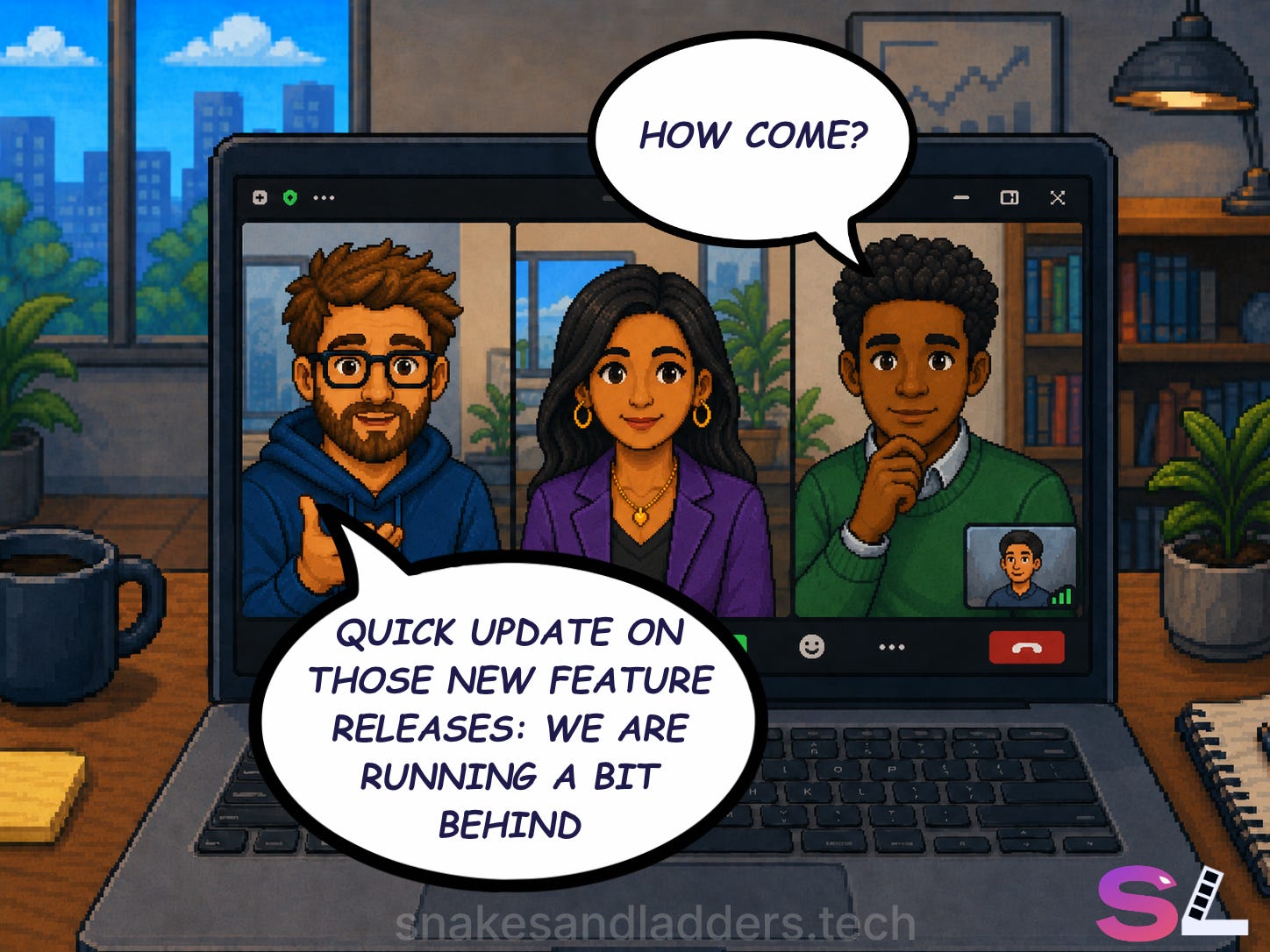
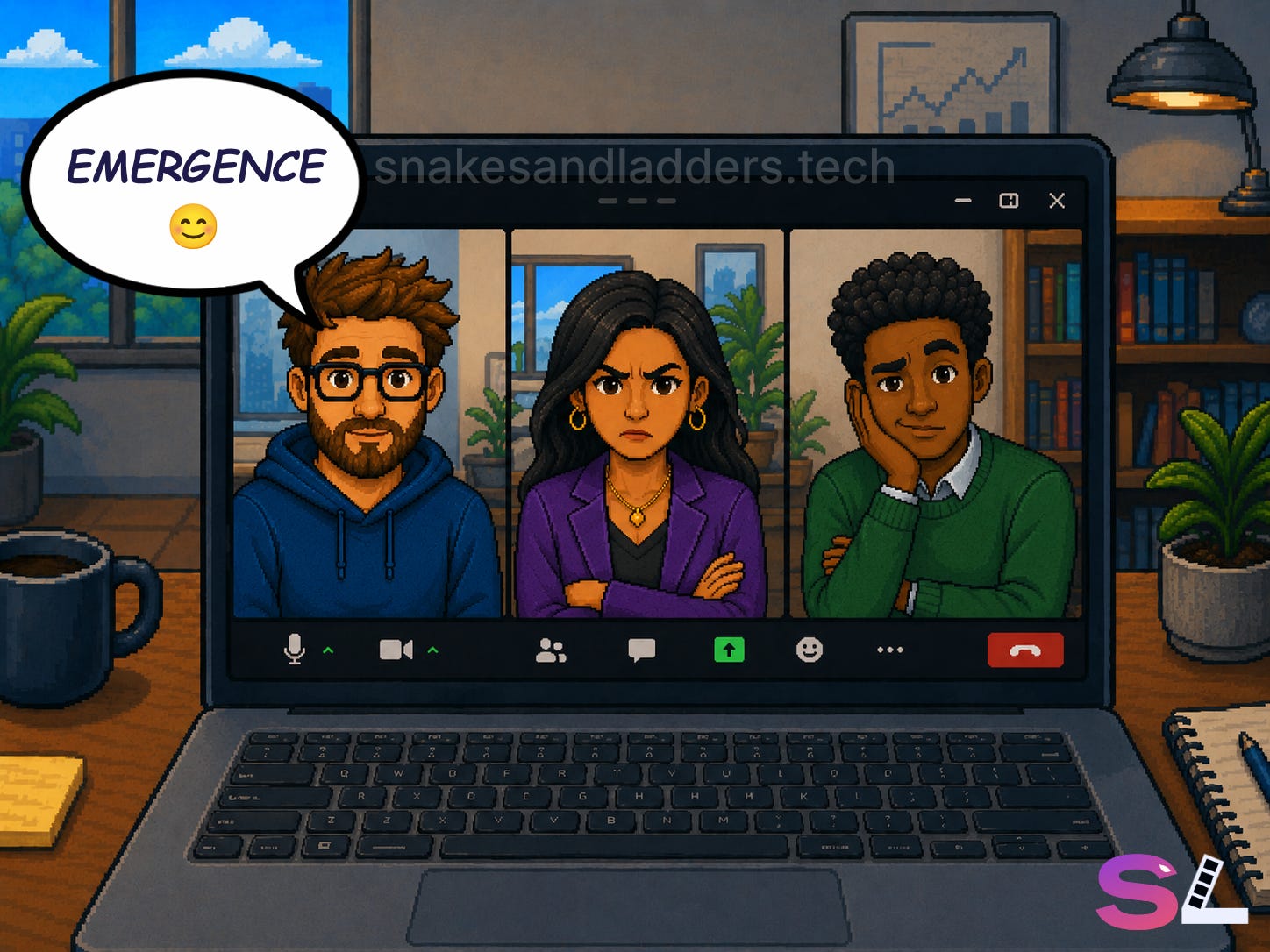
Leadership cannot personally control hundreds of decisions. Our job is to shape:
which information travels;
which questions remain open;
which behaviours receive status;
whether functional targets can yield to shared outcomes;
whether evidence can overturn executive opinion;
how much local judgement people are trusted to exercise.
An outcome nobody could reasonably predict is different from a pattern leadership has watched repeat itself. The first occurrence may be an emergent surprise. If the same failure keeps appearing and the conditions remain untouched, surprise is no longer a convincing management position.
In healthier GTM cultures, responsibility does not disappear at the border between functions. Difficult conversations happen earlier because raising the issue is less dangerous than letting the customer discover it. The result is not harmony. It is fewer surprises, which is considerably more useful.
The revenue system can only perform as well as the culture supporting it.
So when a company behaves rationally or irrationally, look at what people were rewarded for doing, what happened to those who behaved differently, which information travelled and why every decision made sense locally even if the final result did not.
By the time the outcome appears in the revenue numbers, the colony has usually been following the trail for months.
Anderson, P. (1999), “Complexity Theory and Organization Science,” Organization Science, 10(3), 216–232.
Martha S. Feldman and Brian T. Pentland, “Reconceptualizing Organizational Routines as a Source of Flexibility and Change,” Administrative Science Quarterly 48, no. 1 (2003): 94–118